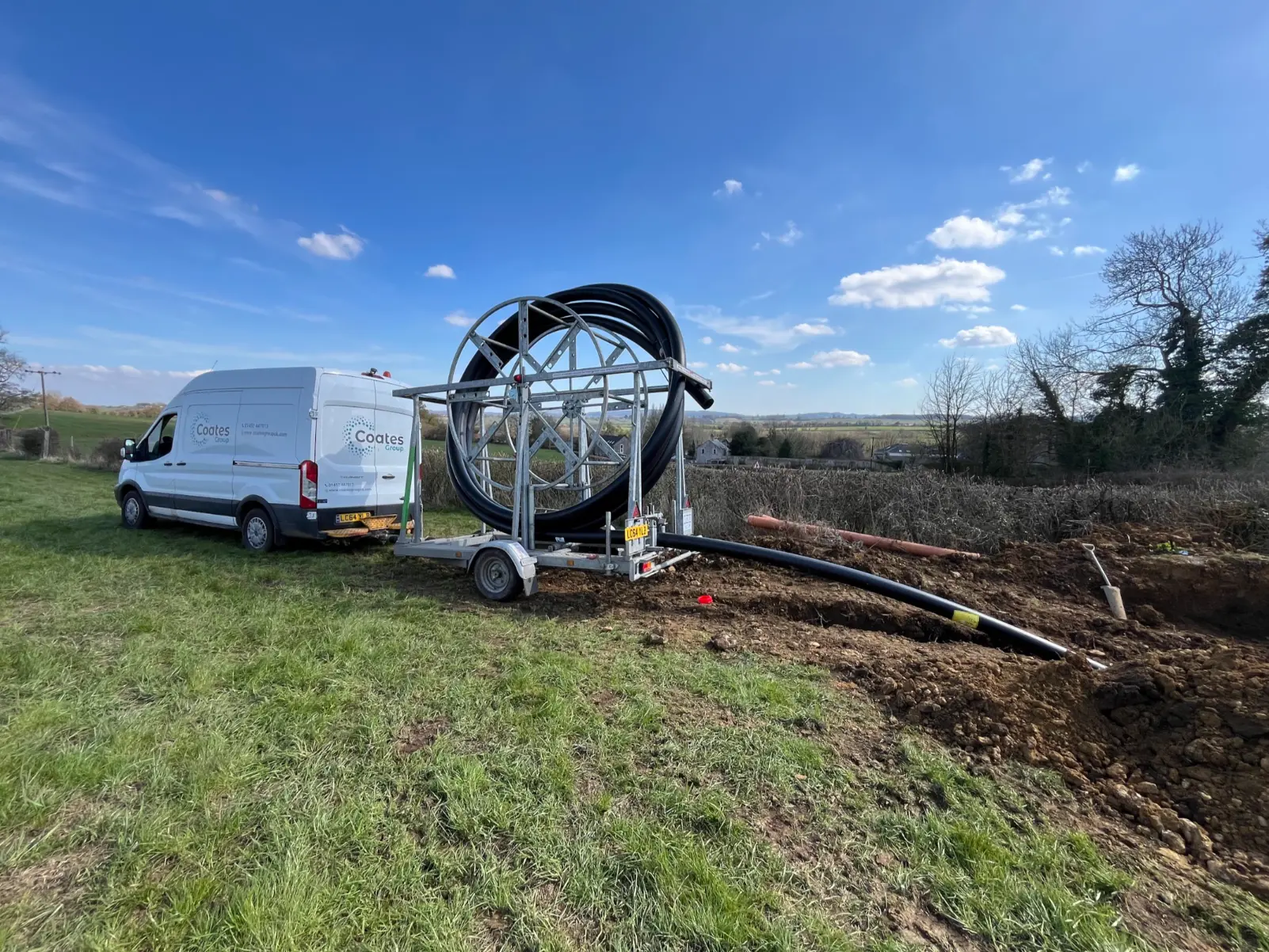
Horizontal directional drilling (HDD) and microtunnelling are both trenchless ways to install pipe underground, but they work differently, cost differently and suit different jobs.
Pick the wrong one and you are looking at higher costs, a longer programme and, in the worst case, a failed install. This guide compares the two across the things that actually decide it, so you can choose with confidence. We are an HDD specialist, and where microtunnelling is the better fit, we will say so.
What Is HDD?
Horizontal directional drilling uses a steerable drill head to create a bore beneath the surface. We open the bore up with reaming tools, then pull the pipe into place through it.
HDD works from the surface. No shafts, no tunnels. The only excavation is two small pits at entry and exit. It suits a wide range of pipe sizes and bore lengths, from short utility connections to crossings of a kilometre or more. Drilling fluid, usually a bentonite slurry, runs throughout to hold the bore open, lubricate the head and clear cuttings.
For the full process, read What Is Horizontal Directional Drilling?
What Is Microtunnelling?
Microtunnelling uses a tunnel boring machine (TBM) or pipe-jacking system to drive pipe through the ground from a launch shaft to a reception shaft. The machine cuts at the face, and lengths of pipe are jacked in behind it from the launch shaft.
It works below ground. You need a launch shaft and a reception shaft. The machine is lowered in, driven forward on line and grade with laser guidance, and lifted out at the far end. It delivers very high accuracy and handles large diameters in a wide range of ground, including hard rock.
HDD vs Microtunnelling: Head to Head
| Factor | HDD | Microtunnelling |
|---|---|---|
| Typical pipe diameter | Small to large (utility through to major mains) | Medium to very large |
| Accuracy | Steered with surface tracking | Higher (laser guided) |
| Ground conditions | Soil and soft rock. Harder in cobbles and boulders. | Soil, mixed ground, hard rock. Handles obstructions. |
| Excavation | Two small surface pits | Two shafts |
| Setup time | Hours to days | Days to weeks (shaft construction) |
| Speed of advance | Faster | Slower |
| Bore profile | Curved (steered) | Straight (line and grade) |
| Pipe material | PE, pulled through | Concrete, GRP, steel, jacked in sections |
| Gravity sewers | Great for pressure pipe, less so for tight gravity grades | Built for accurate grade control |
| Cost (typical crossing) | Lower | Higher (shafts, equipment) |
| Environmental impact | Low (surface-based, small pits) | Moderate (shaft excavation, dewatering, spoil) |
When HDD Is the Better Choice
HDD is usually the better call when:
The pipe is small to medium diameter. For utility and distribution-scale pipework, HDD is almost always cheaper and faster. The time and cost of building shafts for microtunnelling is hard to justify at smaller sizes.
The bore is long. HDD can drill a long crossing in one go from a single rig position. Microtunnelling drives are usually limited before you need an intermediate shaft. For long crossings under rivers, motorways or rural routes, HDD is often the practical choice. We drilled a single bore of around 2 km of 250 mm MDPE water pipework across five fields for Thames Water near Bicester, the kind of reach where HDD has a clear edge.
The path needs to curve. HDD is steered, so it can follow a curved profile to dodge obstacles or hit the right entry and exit angles. Microtunnelling runs straight, on line and grade. On one job we steered a curved bore through eight residential gardens with no surface disruption, which a straight drive could not have done.
It is pressure pipe, not gravity. Water mains, gas mains and telecoms ducts do not need the tight gradient control a gravity sewer demands. HDD accuracy is plenty for pressure installs, which makes it the faster, cheaper option.
Surface disruption has to stay low. HDD needs two small pits. Microtunnelling needs two shafts, which are deeper, larger and more disruptive to build. On sensitive urban sites, HDD leaves a much smaller footprint.
The budget is tight. For the same length and diameter, HDD almost always comes in cheaper, because it skips shaft construction and the slower advance of tunnel boring.
When Microtunnelling Is the Better Choice
Microtunnelling earns its place when:
The pipe is very large diameter. At large sizes microtunnelling becomes competitive, because HDD would need a very large, expensive rig with a big fluid system. Microtunnelling takes large diameters in its stride.
Grade accuracy is critical. Gravity sewers have to sit on a precise gradient. HDD cannot reliably hit the tightest grade tolerances, because the pipe follows the bore and the steering carries some tolerance. Microtunnelling is laser-guided and built for gravity sewer work.
The ground is hard rock. HDD handles soft rock, but hard rock such as limestone, granite or sandstone slows it right down and wears tooling. Microtunnelling TBMs are made for rock and keep a steady advance.
The bore has to be dead straight. Some jobs need a precise straight line and level, such as a sewer between two fixed manholes. Microtunnelling delivers that by design.
There are obstructions in the ground. Cobbles, boulders and old foundations can push an HDD pilot bore off line. A TBM cuts through them and is far less easily deflected.
Can You Use Both?
Yes. Some projects use HDD and microtunnelling on different sections of the same route. A water main might use HDD for a long river crossing, where the curve and reach suit it, and microtunnelling for a short stretch through hard rock or a gravity connection at the far end. Using the right method for each section, rather than forcing one to do everything, gives a better result and a lower total cost.
Which Method Do You Need?
It comes down to four questions:
- What diameter? Small to medium points to HDD. Very large makes microtunnelling competitive.
- Pressure or gravity? Pressure pipe favours HDD. Tight-tolerance gravity favours microtunnelling.
- What ground? Soil and soft rock favour HDD. Hard rock or obstructions favour microtunnelling.
- How long? Long crossings favour HDD. Short drives in good ground suit either.
Not sure which way to go? Tell us about your project and we will assess it honestly. If HDD is right, we will do it properly. If microtunnelling is the better fit, we will tell you that too.